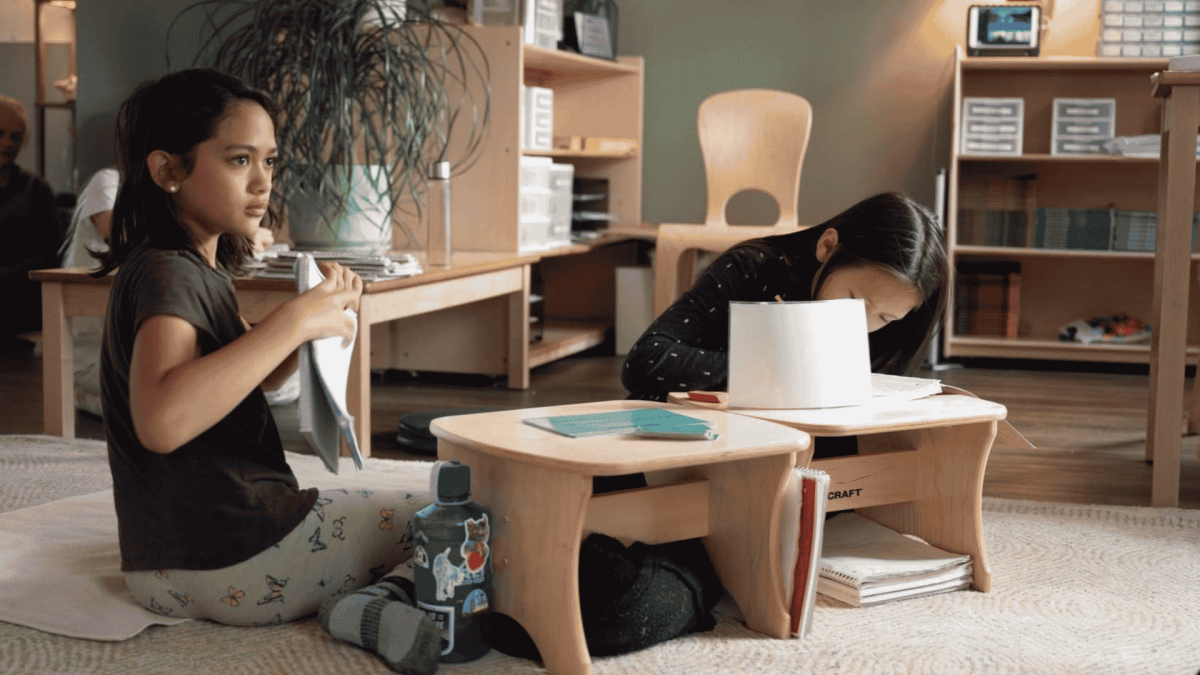
When families compare Montessori vs. traditional school, they are often comparing two classrooms they have never seen side by side. One looks familiar, with desks, a teacher at the front, and a class moving through the same lesson together. The other can look surprising at first, with children of different ages working on different tasks at the same time.
Both are serious, well-established ways to educate children, and both can serve a child well. The real differences sit in how each one groups children, sets the pace, uses time, and defines the teacher's job. This guide explains those differences plainly, looks at what the research does and does not show, and offers questions to help you decide which fit makes sense for your child.
Quick Summary
- Traditional school usually groups children by age and moves a class through lessons together, while Montessori uses mixed-age classrooms and lets each child progress at their own pace.
- Montessori relies on hands-on learning materials and long, uninterrupted work periods, guided by a teacher trained in the method.
- A 2023 review of 32 studies found that Montessori students outperformed peers in traditional settings on many outcomes, with modest effect sizes.
- The best choice depends on your child's temperament, your family's priorities, and what you see when you visit.
Two Research-Informed Approaches
It is tempting to frame the choice as old versus new, or strict versus relaxed. Neither framing is accurate. Montessori grew out of close observation of children and, as MSH describes on its Montessori approach page, is grounded in over a century of classroom practice. Traditional schooling has been refined over generations of classroom experience too.
A fair comparison starts with what each model is designed to do. Traditional school is built to move a group of same-age children through a shared curriculum on a shared schedule. Montessori is built to let each child meet new material when they are ready, inside a carefully arranged classroom.
What a Traditional Classroom Usually Looks Like
In most traditional classrooms, children are placed in a grade with classmates born in the same year. The teacher plans lessons for the whole group, introduces a concept, and then gives practice work that every student completes. The day is usually divided into subject periods, and progress is checked through assignments, tests, and grades.
This structure has real strengths. It is predictable, easy for families to understand, and efficient for delivering the same content to many students at once. Children who enjoy clear routines and direct instruction often do well with it.
What a Montessori Classroom Looks Like
The American Montessori Society (AMS) names five core components of an authentic Montessori program: trained Montessori teachers, the multi-age classroom, Montessori materials, child-directed work, and uninterrupted work periods (American Montessori Society, Pathway of Continuous School Improvement). Each of these changes how a school day feels.
Instead of a lesson for the whole room, the teacher gives short lessons to individual children or small groups. Students then choose work from shelves arranged by subject and difficulty, practice it, and return it when they are done. For a fuller introduction, our earlier post, What Is Montessori? A Huntsville Parent's Guide, walks through a typical classroom.
Montessori vs. Traditional School: The Key Differences
Families who visit both kinds of classrooms often notice the same handful of contrasts. Each one reflects a different belief about how children learn best. None of them makes one model right for every child.
How Children Are Grouped
Traditional schools usually keep children with same-age peers and move them to a new teacher each year. Montessori classes span three years of age, which AMS describes as a way to encourage mentorship among students and leadership development. A younger child watches older classmates at work, and an older child reinforces skills by helping.
The three-year span also means a child usually stays with the same teacher for longer. That gives the teacher time to know a child's habits and interests well. It also means the classroom community carries over from year to year rather than starting fresh each fall.
Who Sets the Pace
In a traditional class, the calendar sets the pace. The group moves to the next unit on schedule, and a child who needs more time, or less, adjusts around that schedule. Teachers in traditional schools often differentiate within lessons, but the shared timeline still shapes the year.
In Montessori, the child's readiness sets the pace. AMS describes child-directed work as giving students agency to choose their work, which supports motivation and sustained attention. The teacher still guides those choices, so freedom happens inside clear expectations.
How Learning Materials Work
Traditional classrooms often teach through explanation, worksheets, and textbooks, with hands-on activities added along the way. Montessori classrooms put specially designed materials at the center. AMS calls these materials a hallmark of Montessori because they provide a hands-on approach to learning.
A typical progression moves from concrete to abstract. A child might handle beads to understand quantity long before writing equations on paper. The goal is for a child to understand an idea physically before working with it in symbols.
The Teacher's Role
In a traditional classroom, the teacher is usually the main source of instruction for the whole group. In Montessori, the teacher is often called a guide. The guide observes each child closely, gives a lesson at the right moment, and then steps back so the child can practice independently.
AMS treats trained teachers as a core component, noting that a properly credentialed Montessori teacher has the skills to carry out the method with fidelity. When you visit any Montessori school, it is fair to ask what training its teachers hold.
How Time Is Used
Traditional schedules often divide the day into subject periods, with transitions in between. Montessori classrooms protect an extended free-choice work period so children can work at their own pace without interruption. A child who becomes absorbed in a project can stay with it rather than stopping mid-thought.
What the Research Says
Families deserve an honest view of the evidence, not just enthusiasm. Research on Montessori vs. traditional school outcomes has grown in recent years, and the strongest studies point in a positive direction while still calling for care in how the results are read.
The 2023 Systematic Review
A systematic review published in 2023 examined studies comparing Montessori and traditional education. It included 32 studies that met its quality standards, including evidence that the two groups were similar at the start (Campbell Systematic Reviews, 2023). Across those studies, Montessori students outperformed traditionally schooled students on a wide range of academic and nonacademic outcomes.
In that review, the size of the advantage was modest. An effect size measures how far apart two groups score, and here positive numbers favor Montessori. The combined effect size was 0.24 for academic outcomes and 0.33 for nonacademic outcomes, with executive function, the set of skills that help children plan, focus, and manage themselves, at 0.36. Effects were larger in randomized studies, in preschool and elementary settings compared with middle and high school, and in private compared with public Montessori programs. The authors also noted some evidence of publication bias, though their sensitivity analysis found the results held up.
Why Results Differ by Setting
The same review found that results were not identical everywhere. Effects were stronger in some kinds of programs than in others, which tells families that the setting and the quality of the school both matter. A Montessori label alone does not produce the results. What matters is whether a school puts the core elements in place every day, with trained teachers, real materials, and protected work time.
That is a useful lens for any school visit. Ask how the school trains its teachers, how long its work periods last, and how it keeps its practice consistent across classrooms. The answers tell you more about likely outcomes than any single study can.
Reading the Research Fairly
Averages describe groups, not individual children. A modest average advantage means many children do well in either setting, and some children will thrive in one more than the other. The quality of a specific school, and how faithfully it carries out its model, matters as much as the label on the door.
Which Approach Fits Your Child?
The most useful question about Montessori vs. traditional school is not which model is better in general, but which one fits your child now. A few questions can help you think it through:
- Does your child enjoy choosing their own activities, or do they prefer clear direction?
- How does your child respond to long stretches of focused work?
- Would your child benefit from staying with one teacher and classroom community for several years?
- How important is a hands-on approach to how your child understands new ideas?
There Are No Wrong Answers
There are no wrong answers here. Some children love the structure of a shared lesson, and some light up when they can move at their own pace. Watching a classroom in person is often the clearest way to tell.
Seeing the Difference at MSH
Montessori School of Huntsville (MSH) is an American Montessori Society Verified School, a status that confirms a school upholds the five core components described above (MSH Accreditation). Each guide at MSH holds a Montessori teaching credential for the specific level they teach, and classrooms use three-year groupings (MSH, The Montessori Approach).
One Campus From Infancy to 9th Grade
A child can grow through every stage on one campus, from Montessori Mornings for infants and their parents or caregivers, Toddler (18 months to 3 years), Primary (3 to 6 years), Lower Elementary (1st to 3rd grade), Upper Elementary (4th to 6th grade), to Adolescent (7th to 9th grade). The programs overview describes what children work on at each level. MSH also describes Montessori and traditional education as well-established, research-informed models, which is the spirit we hope this guide reflects.
Rigor and Readiness in Our Classrooms
At MSH, guides observe each student closely and introduce new concepts at the moment of readiness. Students move forward as they show understanding, beginning with hands-on materials and moving into abstract reasoning over time. The school states that its program meets and exceeds Alabama and national academic standards while staying aligned with authentic Montessori practice. Students also build habits that serve them in any setting, such as concentration, curiosity, collaboration, and confidence with complex problems.
Frequently Asked Questions
Is Montessori better than traditional school?
The 2023 review described above found that Montessori students, on average, outperformed peers in traditional settings on many outcomes, but the average advantage was modest. The better choice depends on your child and on the quality of the specific school.
Will my child struggle moving from Montessori to a traditional school?
Children move between settings at many ages. Montessori classrooms build habits such as focus, independence, and self-management, which apply in any classroom. A school's admissions team can describe how they support families through transitions.
Do Montessori classrooms have structure?
Yes. Children choose their work within clear routines, expectations, and a carefully arranged classroom. The teacher observes closely and guides each child's next steps.
Is Montessori a fit for every age?
Montessori programs serve many ages, and MSH's run from infancy through 9th grade. The 2023 review described above found larger effects in preschool and elementary settings than in middle and high school, so families with older children may want to ask how a program adapts for adolescents.
How can I compare Montessori vs. traditional school in person?
Visit both. Watch how children spend their time, how the teacher interacts with them, and how your child responds to each space.
Choose the Classroom That Fits Your Child
In the Montessori vs. traditional school decision, both options aim to raise capable, curious learners. They simply take different paths to get there. The right choice comes from understanding those paths and seeing them in action.
We would love to show you a Montessori classroom at work. Schedule a private tour to observe our classrooms, or contact our admissions team with any questions about how Montessori might fit your family.