Once you start looking, the word Montessori shows up everywhere: in toy aisles, on parenting blogs, and on the signs outside schools. The word alone tells you very little, though. What gives the approach its shape is a small set of ideas that Dr. Maria Montessori, an Italian physician and educator, developed more than a century ago, and most guides group them into 5 Montessori principles. Once you know them, you can spot them in a classroom, ask sharper questions on a school visit, and even use them at home.
This guide walks through each principle in plain language. For every one, you will find what it means, what it looks like during a child's day, and one simple way to support it at home. We also share how the Montessori School of Huntsville (MSH) puts these ideas to work, from Montessori Mornings for infants through the Adolescent program in 9th grade.
Quick Summary
- The five Montessori principles are respect for the child, the absorbent mind, sensitive periods, the prepared environment, and self-directed learning (often called auto-education).
- Each principle describes how young children learn best: through real choices, hands-on work, and protected time to concentrate.
- You can support every principle at home with small changes, such as child-height shelves, real words, and fewer interruptions.
- At MSH, credentialed Montessori teachers apply these ideas from infancy through 9th grade in mixed-age classrooms.
Where the 5 Montessori Principles Come From
A Method Built on Watching Children
Dr. Montessori built her method on her experience as a doctor and educator. Observation is still at its center: Montessori teachers are trained to watch children closely so they can spot when a child is ready to learn and prepare the room to meet that need. Writers phrase them a little differently, but the most common version names five Montessori principles.
Why the Principles Matter More Than the Name
Any school can call itself Montessori, regardless of how closely it follows the philosophy and practice. That is why the principles are so useful to parents. They give you a yardstick for what you see on a tour and what you hear from a school. A program that lives these ideas will show them in its classrooms, its daily schedule, and the way adults speak to children.
What the Research Says
Montessori is a philosophy, but it is also a well-studied method. A 2023 systematic review drew on 32 studies and found that Montessori education had positive effects on both academic and nonacademic outcomes, with a composite academic effect size of 0.24 and a nonacademic effect size of 0.33 (Campbell Systematic Reviews, 2023). The same review reported moderate-quality evidence for gains in executive function, the set of skills children use to plan, focus, and manage themselves. It also found larger effects in preschool and elementary settings than in middle or high school.
Principle 1: Respect for the Child
What It Means
Respect in Montessori means treating a child as a capable person with real preferences, not as an empty vessel waiting to be filled. In practice, teachers give children free choice in their work and take care not to interrupt a child who is deeply focused. Respect also shows up in small courtesies: adults kneel to talk at eye level, ask before helping, and give children time to finish a thought. These habits tell a child that their effort and attention matter.
What It Looks Like in a Child's Day
A three-year-old might choose between two activities, decide when to wash their hands, or pour their own water at snack time. An older child might set work goals for the week with a teacher's guidance. Mistakes are handled calmly, with a chance to try again rather than a scolding.
Try It at Home
Offer two acceptable choices instead of one command: the red shirt or the blue one, the bath before the story or after it. When your child is absorbed in building or drawing, wait for a natural pause before calling them to dinner. Ask "Would you like help?" before stepping in. These are small shifts, but they build the same sense of trust a Montessori classroom works to create.
Principle 2: The Absorbent Mind
What It Means
"Absorbent mind" is Dr. Montessori's term for the way young children take in information from their surroundings quickly and with little visible effort. Adults tend to learn by studying, while toddlers learn simply by living in a place. That is why children pick up the phrases, gestures, and manners of the people around them long before anyone teaches those things on purpose. The idea carries a quiet responsibility for parents and teachers, since children absorb what they see as much as what they hear.
What It Looks Like in a Child's Day
In an infant or toddler room, adults speak in full, clear sentences and name objects accurately, so a whisk is called a whisk. Materials are real and well cared for, which teaches children that tools have a purpose and a place. Older children watch their classmates work and often copy what they see. The room itself becomes part of the teaching.
Try It at Home
Narrate ordinary tasks as you do them, from sorting laundry to cracking eggs. Use real words, including big ones, and read aloud every day. Turn off background screens when you can, since young children absorb that noise too. Let your child see you reading, fixing things, and cleaning up, because they are watching more closely than it seems.
Principle 3: Sensitive Periods
What It Means
Sensitive periods are windows of time when a child is especially ready to learn a particular skill. During one of these windows, a child may repeat the same activity again and again with unusual focus. The timing differs from child to child, so Montessori teachers watch closely rather than follow a fixed calendar. When they spot a window opening, they offer a lesson that fits it.
What It Looks Like in a Child's Day
A child in a sensitive period for order may insist that shoes go in exactly the same spot every day. A child drawn to tiny details might spend a long stretch threading beads or sorting buttons by size. A child in a language window may ask "What's that called?" dozens of times an hour. Teachers treat these moments as signals to follow, not phases to rush through.
Try It at Home
Notice what your child repeats and insists on doing "by myself." Rather than redirecting, look for a safe way to give them more of it. A child fascinated by pouring can practice with a small pitcher at the sink, with a towel nearby. Keeping routines predictable also helps a child who is craving order feel calm and secure.
Principle 4: The Prepared Environment
What It Means
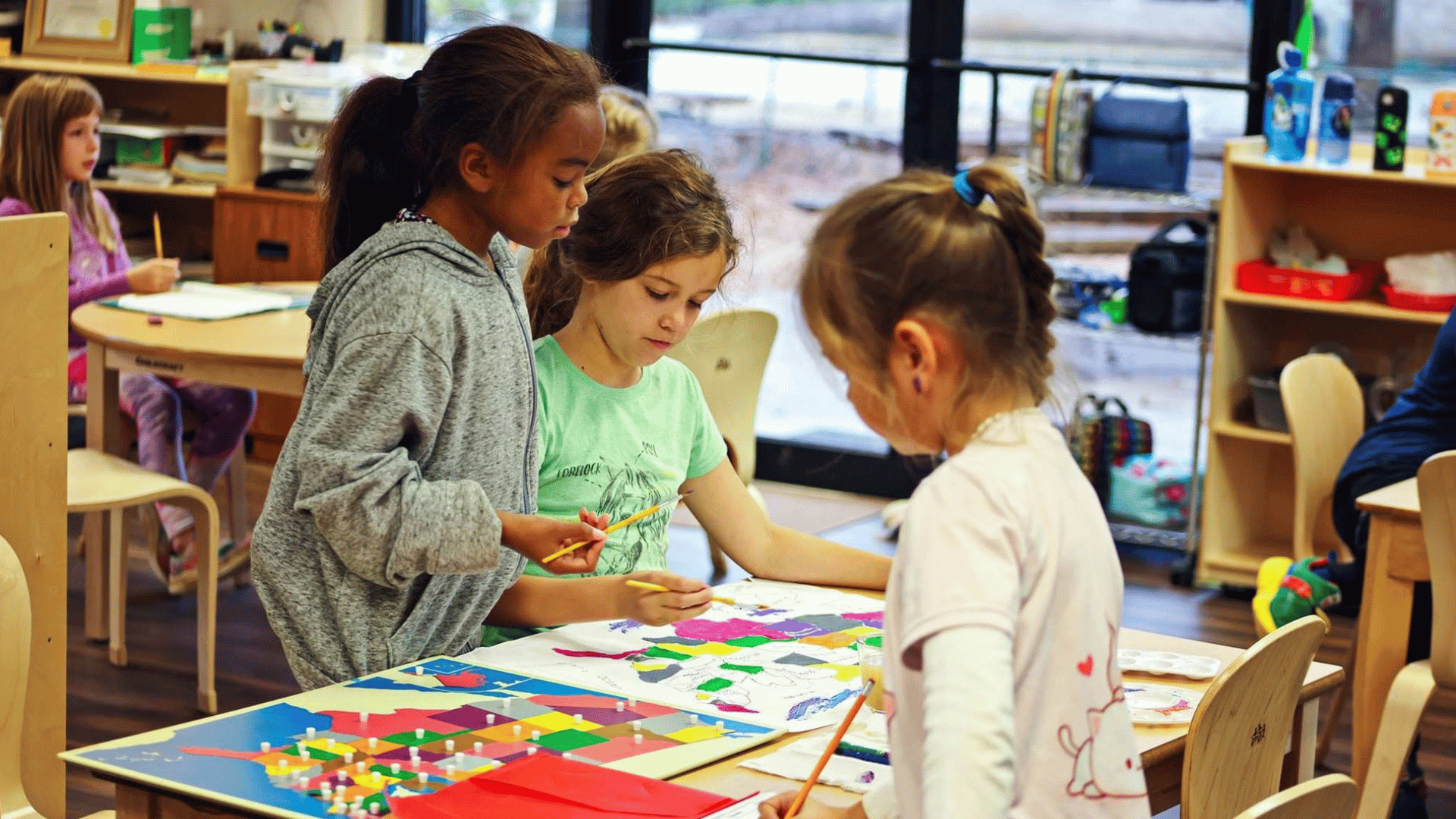
The prepared environment is a space arranged so children can find, use, and put away materials on their own, with everything placed in a sequence that fits their development. Early childhood classrooms often have child-sized furniture, low sinks, cozy reading spaces, and reachable shelves of work available for free choice. Freedom in this setting has clear limits, because the order of the room does much of the guiding. Children learn where things belong and why that matters.
What It Looks Like in a Child's Day
Instead of rows of desks facing a teacher, you see children working alone or in small groups at tables or on floor mats. Each material usually teaches one skill, and many are self-correcting, so a child can notice a mistake and fix it without an adult stepping in. When the work is finished, the child returns it to the shelf for the next person. This simple cycle builds independence, order, and respect for shared things.
Try It at Home
Pick one area to start, such as the entryway or a corner of the kitchen. Add a low hook for a coat, a small basket for shoes, or a shelf with three or four toys instead of an overflowing bin. Rotate those toys every week or two so the shelf stays interesting. A child who can reach their own things will start using them without being asked.
Principle 5: Self-Directed Learning (Auto-Education)
What It Means
Auto-education is the idea that children learn most deeply when they work something out for themselves, while adults provide guidance and the right setting. The teacher's role shifts from lecturer to guide. Montessori teachers systematically observe and assess each student's progress, then give children the support and tools to take ownership of their own learning. Self-directed does not mean anything goes, since the materials and the room are designed with clear goals in mind.
What It Looks Like in a Child's Day
Long blocks of uninterrupted work time give children room to choose an activity, stay with it, and finish it. In early childhood classrooms, these blocks typically run two hours or more (American Montessori Society). During that time, a teacher might give a short lesson to one child, then step back and observe while others work on their own. Concentration grows because it is protected.
Try It at Home
Resist the urge to correct every misstep in a puzzle or a drawing. Ask questions instead, such as "What do you notice?" or "What could you try next?" Build a little unscheduled time into each day for open-ended play. When your child finishes something hard, name the effort rather than praising the result.
How MSH Brings the 5 Montessori Principles to Life
A Continuous Path From Infancy Through 9th Grade
At MSH, these principles shape every level of the school: Montessori Mornings (infants and their parents or caregivers), Toddler (18 months to 3 years), Primary (3 to 6 years), Lower Elementary (1st to 3rd grade), Upper Elementary (4th to 6th grade), and Adolescent (7th to 9th grade). Children learn in mixed-age communities, typically in three-year groupings, so younger students learn from older ones and older students strengthen their skills by mentoring (The Montessori Approach at MSH). Teachers observe each student and introduce new lessons when a child is developmentally ready. You can see how each level builds on the last on the Programs Overview page.
Credentialed Guides and Accredited Programs
Because any school can use the Montessori name, how faithfully a school applies Montessori principles depends a great deal on its teachers. Lead guides at MSH hold Montessori credentials for the age levels they teach, earned through teacher education programs accredited by MACTE (What Is Montessori?). The school is accredited by SAIS and Cognia and is recognized as an American Montessori Society Verified School, which you can read about on the Accreditation page. Its curriculum also meets and exceeds the Alabama Course of Study, so the principles sit alongside clear academic expectations.
Bringing the Principles Home
Montessori Mornings is one example of these ideas reaching into family life. It is a nine-week program in which infants and their parents or caregivers learn together, with practical guidance on creating a Montessori-inspired space at home and responding to a baby's developmental cues (Montessori Mornings). It is not a drop-off program, so adults practice the same principles described in this guide right alongside their child. For families with older children, the Resources for Parents page offers more ideas.
Frequently Asked Questions
What are the 5 Montessori principles?
The five Montessori principles most guides list are respect for the child, the absorbent mind, sensitive periods, the prepared environment, and auto-education, or self-directed learning. Together they describe how children learn through choice, hands-on work, and focused time. Each one shapes how a Montessori classroom is arranged and how its teachers respond to children.
Are Montessori principles just for preschool?
No, they apply from infancy through the teen years, though they look different at each age. A toddler might practice independence by pouring water, while an adolescent might manage a long research project or a small business, as students do in the MSH Adolescent program. At MSH, the same principles guide every level from Montessori Mornings through 9th grade.
Can I use Montessori principles at home without a Montessori school?
Yes, and many families do. Simple steps such as offering choices, lowering a shelf, using real words, and protecting your child's focus all reflect these ideas. A Montessori school adds trained guides, specially designed materials, and a mixed-age community that are hard to recreate at home.
How can I tell if a school truly follows Montessori principles?
Look for teachers who hold Montessori credentials for the level they teach, mixed-age classrooms, hands-on materials, and long, uninterrupted work periods. These are widely seen as core parts of a high-quality Montessori program. A visit is the clearest test, because you can see whether children are choosing and finishing their own work.
See the Montessori Principles in Action
Reading about Montessori principles is a good start, but watching children work in a prepared classroom makes them click. MSH offers private tours for parents and caregivers, and you can book a private tour online. If you have questions first, contact our admissions team and we will be glad to help.
If cost is part of your decision, the Tuition and Fees page includes a tool to estimate your family's cost. Eligible families with students in kindergarten through 12th grade may also use Alabama's CHOOSE Act education savings account, and MSH is an approved provider; see our CHOOSE Act page for details. We would love to show you how these five ideas shape a child's day.